Showing posts with label Seshat. Show all posts

Thursday, October 31, 2013

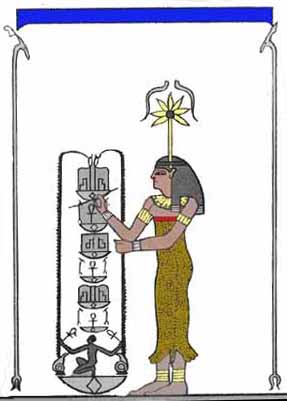
The 7 Pointed Star of Seshat Is The 1st Gnomon

Currently I am reading a book on the symbol of seshat that correlates its look and style of the look, style, and function of the vertical gnomon. It has been said that the closer one gets to truth the more applicable it is to many situations. Wiki defines a gnomon as:

A gnomon [ˈnoʊmɒn] NO-mon, from Greek γνώμων, gnōmōn, literally "one that knows or examines",[1][2] is the part of a sundial that casts the shadow.

The term has come to be used for a variety of purposes in mathematics and other fields.

Anaximander (610–546 BC) is credited with introducing this Babylonian instrument to the Greeks.[3]
Oenopides used the phrase drawn gnomon-wise to describe a line drawn perpendicular to another.[4]
Later, the term was used for an L-shaped instrument like a steel square used to draw right angles.
This shape may explain its use to describe a shape formed by cutting a smaller square from a larger one.
Euclid extended the term to the plane figure formed by removing a similar parallelogram from a corner of a larger parallelogram.
A three dimensional gnomon is commonly used in CAD and computer graphics as an aid to positioning objects in the virtual world. By convention, the X axis direction is colored red, the Y axis green and the Z axis blue.
Hero defined a gnomon as that which, added to an entity (number or shape), makes a new entity similar to the starting entity.
In this sense Theon of Smyrna used it to describe a number which added to a polygonal number produces the next one of the same type.
The most common use in this sense is an odd integer especially when seen as a figurate number between square numbers.
NASA astronauts used a gnomon as a photographic tool to indicate local vertical and to display a color chart when they were working on the Moon's surface.


The cantilever spar of this cable-stay bridge, the Sundial Bridge at Turtle Bay in Redding, California, forms the gnomon of a large garden sundial


Gnomon situated on the wall of a building facing Tiradentes Square, Curitiba

The Chinese also used the gnomon, mentioned in the 2nd century Nine Chapters on the Mathematical Art as being used much earlier by the Duke of Zhou (11th century BC).

In the northern hemisphere, the shadow-casting edge is normally oriented so that it points north and is parallel to the rotation axis of the Earth. That is, it is inclined to the horizontal at an angle that equals the latitude of the sundial's location. At present, such a gnomon should thus point almost precisely at Polaris, as this is within a degree of the North celestial pole.

On some sundials, the gnomon is vertical. These were usually used in former times for observing the altitude of the Sun, especially when on the meridian. The style is the part of the gnomon that casts the shadow. This can change as the sun moves. For example, the upper west edge of the gnomon might be the style in the morning and the upper east edge might be the style in the afternoon.

Gazalé, Midhat J. Gnomons, from Pharaohs to Fractals, Princeton University Press, Princeton, 1999. ISBN 0-691-00514-1.
Heath, Thomas Little (1981), A History of Greek Mathematics, Dover publications, ISBN 9780486240732 (first published 1921).
Laertius, Diogenes, The Lives and Opinions of Eminent Philosophers, trans. C.D. Yonge. London: Henry G. Bohn, 1853.


The important thing here historically for Africa is this women's symbol of Seshat being correlated to the shadows cast by the vertical gnomon, which is the foundation of architecture and surveying still used today. It is always exciting to explore early history and find connections with modern technology. As the saying goes in aegypt, there is nothing new under the Sun.

Sunday, December 16, 2012

Song to Seshat: The Song of Didiu


This song seems to be similar to what is done when beginning meditation. Calling one's body parts to relax, or sleep. Eckart Tolle describes this process as important in meditation. This process can take ones attention away from thinking. Can I feel the energy inside my hands, can I tell they are there without touching them. After a while most people can tell. That is an enormous step, states Tolle. This causes thinking to slow down. Can you incorporate your whole body. There is no anchor for presence. the inner body is a wonderful anchor for the stage of presence but you have to actively go through the process, not just say I am going to stop thinking about an unpleasant experience and it be turned into a pleasant experience. The mind will do little when really in the body there is not much thinking anymore, asserts  Tolle. These states from Tolle are similar to statements you will find from anyone who does meditation in modern times. But what about in Africa? What were the ancients speaking of or doing when they called their body parts during prayer. Seshat was certainly a part of this process. As was her star symbol. Provided are some snippets are of ancient Egyptian text for you to ponder.

From http://www.osirisnet.net/tombes/nobles/antefoqer/e_antefoqer_04.htm
The song of Didiu is a long sequence of dark and obscure references, within which is often found a word translated as "Ninen"
"Heaven is pregnant with the Seshat-star, heaven brings forth the Seshat-star. The Seshat-star is to her mother. Ninen belongs to health, .... belongs to health. The vizier Antefoqer, born of Senet, belongs to health, Ninen belongs to life. The Seshat-star .... 0 Seshat(?), make yourself for Ninen(?) .... Ninen [belongs to] life, the vizier [Antefoqer] belongs to health .... I sleep, I make my own body, these my breasts, these my ...., these my ...., these my fingers, these [vertebrae] of my back. These my .... have not given you to .... Night approaches, it breaks(?), ...., it divides(?) its cup, it pours evil(?) The Seshat-star is to her mother.".
I am interested to know why this piece is called a "song". I have seen this process before in the Book of Coming Forth by Day in which separate body parts are mentioned individually. Taking into consideration that these words are a translation and not exactly what was said the process could have conceivably flowed similar to the meditation process we know of today. For instance, I sleep could mean I am in a relaxed state of rest then proceeding to acknowledge and calling attention to the different parts of the body. Not all are listed here because of the missing parts of the papyrus. Cosmic energy and the Seshat-star concept are very similar in the context of transcendental states. More specifically I am thinking about the Opening of the Mouth Ceremony and its connection between humans and the cosmos.

Monday, September 10, 2012

Spiderman 3 and OSCORP's The Tree Of Life

July 5th, 2012 my family and I went to see the new Spiderman movie while visiting NJ. In one of the early scenes at OSCORP there was a tour given by a lady who explained that the company had their own Tree of Life connecting all of their divisions. I thought that was interesting since I have been seeing Seshat's symbols in movies lately. This movie having as one of its most important actions "transmutation": the ability of a human body to obtain supernatural powers and change at will.  This movie also uses the "honeycomb" symbol I wrote about in my early blogs regarding Seshat and early Egypt, the "Poetic Honey Mead" and the significance of this symbol in ancient KMT.

From my journal notes:
The movie was a lot like secret societies beliefs and what they hold onto of Egypt. The central theme was that of keeping a secret. When Spiderman let out the formula all hell broke loose and he had to fix the damage. If he had kept it to himself it would not have been used for bad. There is that assumption that (myster or mathmematics) will be used wrongly if put in the wrong hangs- as the central vice of the movie. Moreover, that not everyone is to have that knowledge because it solves unknowns, it touches on divinity, and enables manifestation, creation, or innovation. New tools for usage.

This comic is associated with The Brotherhood of the SHIELD. Shields conseal to protect. This "Brotherhood" is said to be from Egypt, according to the historical story line. What is also of note is that the owner of OSCORP, Norman, comes from an Egyptian sarcophacus. There is no doubt to me that the symbolism is intentional. But why are they using African symbols and history in their story telling. To me it is the continueation of a culture of those interested in science, mathematics, astronomy, and so consistently Egypt. So many great, well known "stars" in the scientific realm wrote more books about Egypt's sciences and script than about the math and sciences they were popular in history for, including Sir Isaac Newton and Tesla.

From my half sleep ramblings of connections between the movie and Seshat:

Green reptilian
Blue antegen
Top
Animism atributes
Half human, half animal
Egyptian science of animals godlike features with humans
O S C O R P...Scorpio, osiris,
Mary mother, auntie M, OS like Oz in wizard of OZ. Top of building in large city. Peter lives in Queens, Oscorp is in Manhattan.
Dinner with whole fish per speroson branzino

Tree of life in the movie had a Rnorman osborne in tree, from egyptian sarcophagus.hino and Scorpioan

Brotherhood of the SHIELD
Secret Society from Egypt
Newton, Tesla, Michaelangelo, Da Vinci
divisions are Psi, Black ops, Eye, Strike

From my online search:

"S.H.I.E.L.D. is 2010 comic book ongoing series published by Marvel Comics, premiering with a first issue cover dated June 2010. It details the secret history of the occult organization the Shield. The series is written by Jonathan Hickman and drawn by Dustin Weaver.[22][23][24]

[edit] Plot

The series details the secret history of an occult organization called the Brotherhood of the Shield, with a history extending back to ancient Egypt. The main story of the first issue is set in 1953, when Shield agents Nathaniel Richards and Howard Stark enlist a young man named Leonid with unspecified superpowers into the organization, taking him to Shield's High Council in the Immortal City under Rome. The High Council reveals that they know "the final fate of Man", and their mission is to ensure nothing threatens the world before this occurs. They have chosen Leonid because he has a destiny.[volume & issue needed]
Flashbacks reveal that the Shield was founded by Imhotep following a battle (alongside Apocalypse and the original Moon Knight) against the Brood, and that previous agents include Zhang Heng (who tricked a Celestial into using the sun to give birth to its child instead of destroying the Earth or the Moon to do so), Galileo Galilei (who fought against Galactus) and Leonardo Da Vinci (who is shown with a mysterious device, flying off in an ornithopter).[volume & issue needed]" from wiki

It seems there is a difinate relationship among the science of the ancient Egyptians and the comics, hollywood, and entertainment industry. They are using the symbols and stories of the ancient Egyptians. This does not, however, mean that their stories are of the ancient thought (Thoth).

Sunday, May 27, 2012

Connecting Seshat (7) To Other Regions in Africa

This past week at the Vanderbilt Divinity Library I came across the Encyclopedia of African Religion edited by Molefi Kete Asante and Ama Mazama. In Volume 2 page 610-611 information on the number 7mentions Seshat. On page 608 there is information on her as a non-worshiped deity.

This book describes her as the goddess of writing and measurement and the ruler of books. It states that Djuhuty and Seshat were divine sesh (scribes). It mentions Seshat's name being inscribed on the obverse side of the upper register of narmer's palette. As you know from my previous blogs, I believe there were several divinely inspired scribes (or alternately those who were rewriting from ancient early books) throughout the history of writing, with Seshat (or the women who were scribes) being the first and referenced by those who came after her.

The encyclopedia states, "In pre- or protodynastic times, the people of Kemet used canons, a system of proportions resenting and anthropometric description of the body based on the standardization of its natural proportions expressed in the ratios of Egyptian measures of length for metrological purposes. They knew that the various parts of the human body are constant and immutable in all individuals irrespective of any differences in size and dimensions." The book continues with more information on Seshat stating, "Seshat's inspirations for counting and measurements are demonstrated in city planning, architecture, seagoing vessels, recitations in spells and rituals, writing, medicine, music, and placement of figures in reliefs, bas reliefs, and reliefs en crux" (p609).

Dinger: "god/goddess" or "sky"
Ur III Sumerian cuneiform for An
Moreover, the book provides insight into Seshat and the number 7 in Africa when it states, "The association of the number 7 with wisdom comes with Seshat's title "Foremost of Libraries"(p610). In addition, "Among the Bambara and Dogon, 7 is the number of harmony. It signifies the harmony of the male or masculine, represented by the number 3, whith the female or feminine, represented by the number 4. It has been suggested that the pyramid also embodies the harmony of 7 because it is a 4, square base) topped with a 3 (triangle). Among the Akan, the queens mother's number is 3 and the king's is 4, a different configuration, but still totaling 7. Also amnog the Akan, the number 7 is significant in divination because it is an odd number. The practice of attributing gender to numbers is found throughout Africa." The grouping of 4 +3 is also seen among the Sumerians where the determinative used for deity or god/goddess was a seven pointed star later represented with 4 points and 3 lines, this symbol also doubles as the ideogram for sky. There are 7 gods who decree, 4 primary (Anu, Enlil, Ki, and Enki) and 3 sky gods (Ishtar, Sin, and Sama). This is just one of the many ways that ties other cultures in Africa with the knowledge that was taught in Kemet/Egypt nearly 7,000 years ago with the introduction of writing. One of the main differences in the transfer of knowledge from generation to generation among the people of the Nile Valley and the rest of Africa is through writing, which the Egyptians prized as timeless having writen on papyrus which has not biodegraded in thousands of years. The Nile Valley is very unique in that its inhabitants are in a dry arid area that is also lush within proximity of the Nile River. This enables them to use materials that do not biodegrade for building and burial. In other areas of Africa where people live was not conducive to materials that support building that last thousands of years or papyrus. The dominant means of transfer of knowledge was through the oral tradition. However, the cultural similarities of the early Egyptians are found in other African cultures from hairstyles that still are worn today that were adorned by pharoahs to festivals and manner of speech.

The encyclopedia also provides examples of how the mathematics and sacredness of the number 7 in ancient Kemet is also found to be sacred among other cultures in Africa. It states, "The number 7 is also central to egyptian mathmatics, the fundamental equation 1+2+4=7 reflects the egyptian method of calculating based on continued doubling. Further, when 7 is multiplied by doubling, the first three multipliers are always 1, 2, and 4, which equals 7. These equations factor into the Egyptian table of length used to calculate pyramid measurements. Egyptian fractions are calucalted by muliplying them by the number 7." although 7 is a conspicuous number in many cultures, it is also taboo. The Kolokuma Ijo associate the number 7 with great divinities, so it is to be avoided. Among the Mandak and Ga, the avoidance of the number 7 is found in speech where 7 is referred to as 6+1..Malinke, Mbundu, Kikuyu..use a non number name for 7, mug-wanja, and people do not divide things in portions of seven nor do children travel in groups of seen. Seven curses can ve evoked, each represented by seven sticks aimed at the victim....Kamba circumcision festivities span 7 days, and cracking a whip 7 times brings good fortune to elephant hunters. ..There are 7 elemental powers: darkness, light, air earth, water, fire and blood. In the mythology there are seven hathors, seven souls or ra, seven nomes of egypt, seven stages of the solar bark, seven glorious ones, seven servants of horus, seven with anup at the popel, seven molders with ptah, seven souls of atum ra, seven assistants to maat, seven wise masters of arts and sciences who assist ptah in his measurements of the earth, seven who assist ausar in amenta, and seven states of ptah's creation. Seven also factors into egyptian funerary culture. In royal tombs as early at 3100 BC seven sacred oils were used to anoint the body during funerary rituals. The specific oils are not known, although it is speculated that lotus and cedar are among them. The step pyramid at saqqara, part of an ancient burial complex has seven steps."

The book further gives insight into the Dogon mythology which relates to the word, knowledge, writing, and the scribal art signified by Seshat in predynastic Egypt, as represented on Narmers palate, where her iconography was central to the word or "script", particularly those words or instructions connected with the heavens or were considered divine. It was this scribal art of the early times that led to the development of papyrus which later held the science of astronomy and mathematics used in architecture. Through the centuries this became ritualized in the stretching of the cord ceremony. But originally the word, papyrus, he heavens, and creation stories were written and represented with Seshat then later Dhwty/Thoth, known as "lord of the holy words", who was again later identified with the Greek Hermes Trismegistus. "Words to be spoken" on papyrus were translated as "Spells". I think that these concepts taught can also be found in other parts of Africa as the encyclopedia explains, "Among the Dogon the spirit of the seventh ancestor is responsible for world order. This spirit also wove a cloth that is a manifestation of the Word and imparted it to humanity. The word for the cloth is soy meaning "it is the spoken word." Soy is also the word for seven. In addition, during the creation process, the Dogon supreme deity, Amma, spun seven worlds above and seven worlds below. Inside the first seed of creation the po, there were seven vibrations. Each vibration represents a stage in the development of life. The image of the po seed with seven lines of various lenghts extending from its center symbolically preresents Amma as twins, or masucline and feminine. Two lines are for the head, two for the arms, two for the legs, and one for the sex organ. Here again we see seven as the unity of male and female. This is also the case among the Bambara, a group related to the Dogon. The Bambara hold seven to be a unity of male and female, as well as intelligence and earth. Among the Zulu, there are seven judges for eternity, the abakulu. In the diaspora, the spiritual significance of seven manifests in the Seven Powers of Africa, which are a selection of seven orisha from the Yoruba tradition. These are found in Spanish speaking areas of the diaspora as well as in the African American conjure and folk traditions....The 7th child of a seventh child was believed to be spiritually powerful....seven is the number that denotes God, which according to their teachings is man." Denise Martin Ancient Egypt, Light of the world and African Counts: Number and Pattern in African Cultures.

Thursday, May 24, 2012

A Thousand Words

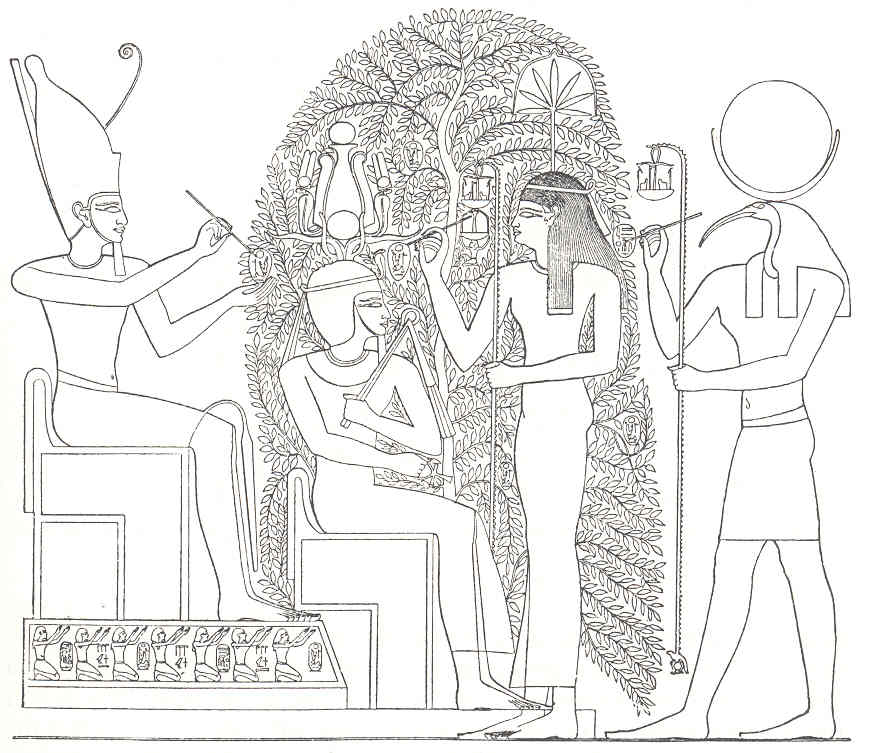
Ramesses II sits beneath the cosmic Ished
 as the gods Attum, Seshat and Thot write his names and years on its leaves. (from the Ramesseum)

The other day I took some time out for myself to visit the local $2 movie theater. Eddie Murphy used to be one of the best comedians and I remember when people went in droves to see RAW. So feeling nostalgic about the Eddie Murphy of my youth, I decided to see "A Thousand Words". Although I had not seen any of the previews and knew nothing of it's content, I was pleasantly surprised.  Overall,it was a good movie and quite funny. Not only that, it's plot centered around the Tree of Life and the book publishing industry. Specifically, the quest to publish a book to impact millions of souls.


In the movie, Eddie Murphy's character, Jack McCall, had to work through the trauma of feeling abandoned by his father, who left when he was young. This struggle led to him being closed off to his true self, the person he was meant to be. It was a story of self discovery which led to a spiritual and genetic connection through meditation and magic. These lessons were inundated with imagery of a magical Bodhi tree with falling leaves intertwined with the plot of a black man who was the top dog at a book publishing firm. Mark my words, this may be Eddie Murphy's comeback movie.

One of the central turning points in the movie is when Jack "sees the blue pearls". This leads to an epiphany just prior to his blood getting on the tree. The color blue is my favorate color so I like to hear it being talked about in a positive light. This led me to wonder what the blue pearl in this movie signified, so I Googled it. One website states that the pineal gland and the blue pearl or crown chakra are the gateway to heaven. It is said also that by meditating on the blue pearl, which is inside the pineal gland, one can eventually receive guidance from one's higher soul. The outward appearance of spiritual work on this is the "laying on of hands".

Chakravatin, King Ashoka Chakra 

Mahabodhi Temple
Mahabodhi Temple,
"Great Awakening Temple"
site of the Bodhi tree

In the movie Jack does not speak because of this phenomena connecting him with the Tree of Life, represented by the Bodhi tree. In ancient times, Indian emperor King Asoka (304-232 BC) paid homage to the Bodhi tree at the Mahabodhi Temple, and held a festival every year in its honor during the month of Kattika. It is said that in the end times, lotus will grow here. It is also at this temple that Buddha spent 7 weeks at 7 spots meditating and considering his enlightenment experience. Several specific places here relate to the traditions surrounding the 7 weeks. In Bangladesh and India, Kartika is the 7th month which begins with the suns entry into Scorpio. This is during mid October on the Gregorian calendar and ends November 15th. In some African cultures, it is forbidden to say the number 7. So speech and absence of speech is connected with this divinity. In Egypt, Seshat is nameless. To call her name at the New Year hour is to give one power. The number 7 is taboo also among the Kolokuma of the Ijaw in Nigeria, Malinke (descendants of the Mali Empire), Mbundu, Kikuyu and Kamba (Bantu people in Kenya), to name a few. Among the Mandak and Ga, the avoidance of the number 7 is found in speech where 7 is referred to as 6+1 according to the "Encylcopedia of African Religion" (p 611).

"Among the Dogon tribe in Africa the spirit of the 7th ancestor is repronsible for world order. This spirit also wove a cloth that is a manifestation of the Word and imparted it to humanity. The word for the cloth is soy meaning "it is the spoken word". Soy is also the word for seven." states the Encyclopedia of African Religion. Also in a book by Shannon Dorey called The Nummo about the Dogon the author further connects mathematics, the word, speech, and 7 with the Dogon and Egypt. The author states "The number 22 is the measure of the circumference of a circle when the diameter is 7. At one time this proportion, known as pi, was a religios secret. The circle is a symbol of immortality and seven relates to the Master of Speech (identified with the number 7 p152)....In the Dogon religion the "word" was a symbol for DNA....The words which were in the tonu soy of the po, Amma made them come out and gave them to the Nommo: this became the cloth that cannot be broken. According to the Dogon, the rope represents the unbreakable tie Amma had established between the ancestors and their descendents. The cloth in this passage is another representation of the "word", or the DNA that is a part of all life and identified with Amma. This same symbolism appears in Catholic iconography and was discussed....in relation to priests being "men of the word" and "men of the cloth".  So here again we see how the teaching of science and mathematics is passed down through story telling in African culture.

The god Osiris paints Pharaoh's
name onto leaf of the
Tree of Life. Karnak.
Because the number 7, Seshat, the Tree of Life, and books are the topic of this blog I thought it fitting to talk about this movie which includes all of these themes in the plot. The only movie I haven't commented on that I have seen at this discount theater is Avatar, another "Tree" movie. Now, is it me, or is Hollywood, the city of stars, spending a lot of energy on Tree of Life movies which, in their various forms, include attributes of Seshat? I hope that you enjoy this movie as I have and add your comments to this blog on your insights.

Sunday, February 12, 2012

Norse's Yggdrasil and the Tree of Life

Written 2/12/12
Yggdrasil is the tree of life of the Old Norse. sacred tree at Uppsala was a sacred tree located at the Temple at Uppsala, Sweden, an evergreen tree. The European Yew grows in Northwest Africa, Iran,Europe, and Southwest Asia. In the Canon of Medicine (1021) the drug from this tree was named Zarnab, and was used as a cardiac rememdy. It is used today in a synthetic form for chemotherapy and in the Central Himalayas, the plant is used as a treatment for breast and ovary cancer. Taxanes, which comes from the plant,  freezes mitosis and stops cell division. Coincidence that such a plant has been honored as the tree of life among some cultures who have kept Egyptian science embeded in their rituals.  Ancient KMT medical science restored. (from my notes dated 6/28/11).

Tomb of Pashedu, Valley of the Kings
Tree, Snake,
Yggdrasil is commonly held as the Ash Tree. I found this noteworthy because this week (2/10/12) I was searching for the etymology of Nashville as I was preparing an itenerary to create a "Discovering Egypt in Nashville" tour. Interestingly, Ash is in the olive and lilac family. What was interesting to note for me was that Ash exudes a sugary substance that was fermented to create the Norse "Mead of Inspiration". My quest for the meaning of Nashville brings me back to Seshat! Yet again connecting masonic thinking to ancient Egypt. I say masonic in reference to the architecture and name for Nashville. While Nashville has several noteworthy architectural references to Egypt finding a suitable name for the city was also of importance. The sound Nash is said to come from Atten Ash which means near an ash tree. We will see stories from Egypt of those near the tree. The term Nash was a shortened form of Aten ash in old English. The Ate was dropped phonetically. Other related terms include Ash/As, Ashemu, Ashtoreth, Ashorath, Ishtar, Isis, and Astarte.
Tomb of Thutmosis III, KV34,
1400s BC 18th Dynasty
Breast-like fruit growing from the trunk of the sacred yaxche tree

According to Norse mythology drinking the milk of the Ash tree makes one a skald or scholar. Is it no wonder that Nashville is home to so many colleges.

One website on the tree of life notes,
"In tomb depictions, the deceased, frequently accompanied by his wife, was shown sitting under or near the branches of a tree, with Hathor sprouting from the trunk, enjoying the fruit and drink offered by this goddess. An excellent example of such a representation is in the Theban tomb of Sennedjem.
Scenes and inscriptions clearly show a link between the tree-goddess, the symbol of renewal, and the dead in the form of the avian Ba, for as a bird, the soul of the dead was attracted to, and nourished by the tree."
As in its ancient Egypt and South America, the Norse retelling of the script also uses the representation of a bird.
Chased by Suttungr, Odin spits the mead of poetry into several vessels.
Jakob Sigurosson, 18th century Icelandic artist.
File:Odin wins for men the magic mead by Willy Pogany.png
Ogdin wins for men the magic mead
In this version of the story the "rhymester's share" (skaldfifla hlutr) could be drunk by anyone. However the mead of poetry was given by Odin to the Gods and to the men gifted in poetry. I think of rappers delight.... In the Norse story it references Aegin, a god coming from the sea (foreign). The Ae combo was a representation of the tree goddess in script.  this further connects the Norse's Yggdrasil with the Egyptian Tree of Life. Scholars/Skalds are shown to be connected to Ssh/she who scrivens/7/tree goddess in many cultures. Knowledge, script, and stories wrapped in parables exist cross culturally  that tie us to Lady Wisdom of the Pre-Dynastic times. Ancient Africa/KMT history told by authors across the world. The knowledge of self is transformative. 

I will leave you with some small tidbits on mead. I encourage you to search this subject and read my other blogs about mead, honey wine, and bees/honeycombs.  "Mead: In Scythia it was called medos; in Greece, methu; in India, madhu; in England, mead; in Old Irish, mid; in German, meth; in the Slavic countries, medu; in Lithuanian, medus; etc. The East-African nomadic races not only eat the wild honey but they dilute it with water and let it ferment into wine or beer called tetsch, which is their favorite drink. The African soothsayers and prophets intoxicate themselves with this honey-wine. During ceremonials and magical practices it is liberally used. They drink it from horns, like the Niebelungen used to do, and also distil it for brandy."

Friday, February 10, 2012

The Daughter of the Eye

Hide me in the shadow of Your wings Psalm 17:8
When I saw this picture I thought of scripture...as I sometimes gain clarity of script as I study KMT. This picture particularly brought to mind the single eye in the bible and the shadow of wings. For me it was a visual representation of the words I had read. So I just wanted to post this in this context for whats it worth. I will post more on the Egyptian origin of sayings compiled in the book of Psalms.
Matthew 6:22-23 (King James Version)
22 The light of the body is the eye: if therefore thine eye be single, thy whole body shall be full of light. 
Psalm 17:8
New American Standard Bible (NASB)
8 Keep me as [a]the apple of the eye; Hide me in the shadow of Your wings
Footnotes:
Psalm 17:8 Lit. the pupil, the daughter of the eye 
Footnotes: Psalm 17:8 Lit. the pupil, the daughter of the eye (seshat: she who scrivens, mistress of the house of books, lady wisdom...see my blog for more)

Monday, June 27, 2011

References to Lady Wisdom, Seshat in the Bible

She [is] a tree of life to them that lay hold upon her: and happy [is every one] that retaineth her.
Revelation 2:7 He who has an ear, let him hear what the Spirit says to the churches. To him who overcomes, I will give the right to eat from the tree of life, which is in the paradise of God.
 
She is a tree of life to all who take her in their hands, and happy is everyone who keeps her.
Wisdom is a tree of life to those who embrace her; happy are those who hold her tightly.

Genesis 2:9 And the LORD God made all kinds of trees grow out of the ground--trees that were pleasing to the eye and good for food. In the middle of the garden were the tree of life and the tree of the knowledge of good and evil.
Proverbs 4:13 Hold on to instruction, do not let it go; guard it well, for it is your life.
Proverbs 8:34 Blessed is the man who listens to me, watching daily at my doors, waiting at my doorway.
Proverbs 11:30 The fruit of the righteous is a tree of life, and he who wins souls is wise.
Proverbs 13:12 Hope deferred makes the heart sick, but a longing fulfilled is a tree of life.
Proverbs 15:4 The tongue that brings healing is a tree of life, but a deceitful tongue crushes the spirit.
Ecclesiastes 7:12 Wisdom is a shelter as money is a shelter, but the advantage of knowledge is this: that wisdom preserves the life of its possessor.

Saturday, June 25, 2011

Seshat, The Tree of Life, & Operation Odyssey

In March of this year Libya, the land of the ancient women who ruled, was attacked in a war that has been coined Operation Odyssey. My interest in Libya began with my research of Seshat and women who were ancient writers in Africa in 2011 because of an ancient script called Tifinag. Tifinag was used among the Libyan women and was intricately tied to matrilineal societies and the early women of Egypt who were scribes for the tracking of property, lineage, etc.. 

The history of early writing, women, agriculture, and land ownership in North Africa was tied to this early writing and the heiroglyphs that developed in Egypt. The early forms of writing, knowledge, and wisdom were represented by "she who scrivens" which was related, in my opinion, to matrilineal society. According to wiki, "Matrilineality is a system in which lineage is traced through the mother and maternal ancestors. Matrilineality also is a societal system in which one belongs to one's matriline or mother's lineage, which can involve the inheritance of property and/or titles."

In my research of the early history of writing in Egypt I saw a correlation to the culture of the women in Libya who were writers and the symbol Seshat "she who scrivens". Gadhafi, the leader of modern Libya, had a desire to display women today as they were in the ancient days also known as "Amazon Women" warriors.

The timing of the war against Libya seemed strategic so I took note of its name and saved this bit for future reference. According to Wired, "The U.S. military’s nickname for the no-fly zone in Libya sounds like the beginning of a long adventure. But Defense Department officials insist that there’s no hidden meaning behind 'Operation Odyssey Dawn.' It’s just the product of the Pentagon’s semi-random name-generating system." So here we have the women of Libya in the news, at a location I consider to be the hub of early writing systems represented by gardens, trees, and papyrus (paper) to the anceints.

Fast forward to June and The Tree of Life, written by Terrence Malick, is about to hit the theaters. It comes out 7/1/11, the day of a solar eclipse. Of course its reference to the Tree of Life caught my attention when I saw it advertised with Thor, so I googled it. The film opens with a quotation from the Book of Job, when God asks, "Where were you when I laid the earth's foundation...while the morning stars sang together and all the angels shouted for joy?" Then a waving light like a flame emerges. As you know from my previous post Seshat was the Mistress of the House of Architects and instructed in the laying of the foundations through her wand and headress which was connected to the stars. I think of tools such as an astrolobe and books about geometry when I conceptualize the need of early architechs and surveyors to honor Seshat to legitamize their work, her "school" was their branding.

Sean Penn is an architect in the movie. It is the moment of a planting of a tree that the central reminiscence of the film begins. Now a movie titled the Tree of Life with a central character as an architect that uses imagery of astronomy, tree of life, number 7 and 11, laying of foundations, etc., all central themes of Seshat obviously is using her symbolism but why?

This is a brief synopsis of how the Tree of Life (symbol of Seshat) and Libya (Operation Odyssey) have integrated in the past. How it integrates in the present and future is yet to be seen as this drama unfolds. I will post more after I see the movie.

Sunday, May 8, 2011

My Night At The Movies, A Review of "The Adustment Bureau" and "Thor"

Thursday evening, May 5, 2011, my husband and I went to the movies. I had no idea what movies we were going to see, so it was quite a surprise. The first movie was called "The Adjustment Bureau" which started at 9:40pm at the discount theater, the second was "Thor" which started at 12:01 am at a regular theater. I am going to provide a review on this blog because I am now beginning to see more things through a lens filter of "Seshat". I find I notice more correlations with the ancient goddess and what she represented as I learn more about its history. I am writing my review of these movies as I see how they are modern displays in art of ancient concepts and symbolism. My trip to Hollywood in February, a true city of stars, left me more interested in Hollywood's relationship with the star goddess.

Back to the movie...Overall my impression of the first movie was that it was a great love story. Its not often you find a man that intent on having a women, and a man of stature at that, who, one would think, could have any women at his beckon call. One of the key characters who aided in the seeking of the truth and the correction of the plans that were in error happened to be an African-American male. Which I thought may have been strategic after noticing there were hardly any other people of color in the movie at all. It is my view that whoever wrote this has some knowledge of ancient Egyptian teachings, but I do not consider it to be a true representation of the teaching, just influenced by. I noticed that this character did not admit to being an angel or disclose the name of who was in charge of these writings. He did make it clear in the movie that we  have the power to change things, free-will.

So why does this movie remind me of Seshat and this blog? It is full of similarities, primarily "the Hall of Records", the fate of rulers being written (not everyone), the Statue of Liberty, and magical abilities that transcend time. In true transfiguration style, they are able to use a vortex to enter doors that lead to other areas which allows them to travel faster. The door in this scene leads to "Lady Liberty" whose relationship to Seshat I posted previously. This scene at Lady Liberty also marks an important turning point in the movie. It is at this moment that Elise, the main female character, chooses him. Also, the one door that leads to the "House of Records" is at this location.

The movie deals with fate, which Seshat is often seen as etching the time of the politicians of Egypt. Their plans and longevity in office were determined and recorded by her. How long they would rule was indicated by notches placed on the palm leaf stalk. The divine measurer of time. She kept a recording of the lives and deeds of men on the sacred persea (ished) tree at Heliopolis, "City of the Sun". These plants may have been used to make their paper, which was used to record such things. The paper of the Egyptians was designed for longevity and has lasted for thousands of years intact.

In this scene the film filter shifts from the color blue to green and they are on grass, by the ocean, and the sun begins to shine. The main character, Matt Damon, was a politician who was to win 4 more elections and was to go very far politically, but the plans were rewritten mysteriously. It was thought that she would keep him from going far politically and he would keep her from achievement in dance. Their love was only good in small doses. At the end of the this part of the movie when the error made in 2005 is corrected and the story is rewritten in the book, they are able to love each other, the rain stop and the sun comes out and shines over the city of New York. Light concurs darkness. But sometimes you must go through the rain to reach truth, as was case in this movie.

The Adjustment Bureau is about fate, destiny, and  free will. One website explains Seshat relationship to fate
In Egyptian thought the concept of fate (shaï) is always imagined in connection with writing, and hence Seshat is a Goddess of fate as well, which in Egyptian theology paradigmatically involves reckoning the lifespan. The divine command is written down, not as a mere record, but to render it concrete, and the writing of it is inseparable from its enforcement.
This concept of fate was typified in the movie at the turning point scene at the statue of liberty when they entered the door to the Hall of Records where they sought to change what was written in the book of life.
The book that came from the Hall of Records looked very much architectural in nature. The plans, measures, and blueprints were very Seshatish to me. The number 7 came up a few times in the movie. 7 is the symbol of Seshat. She was also called the "Mistress of the House of Books". The main point to the movie was that we have the power to change what is written. However, in the end, it was just noted that in 2005 someone made an error that had to be corrected, so what was written originally actually did occur in the end.

The next movie we watched was Thor, which started at 12:01 am. I am sure someone can comment as to why. I was sure I had seen Thor recently while researching Thoth and Seshat among the Europeans. So I did a quick search on my cell phone for Thor and Thoth and sure enough there was a connection between the two. I began to feel like my evening was planned, or I had better provide more content on my blog so here goes. There is not much I have to say about Thor, other then going into the research behind the Greek gods and their relationships with early Egypt, which is an entire post in itself. In the movie Thor there was the concept of transmutation, traversing through wormholes, timelessness, and fate. They did touch on magic and science.  Which for me in the study of Seshat is important because there is a lot of writing that talks about magic as it pertains to medicine and such. However, when I go back and read much of it such as in Medea when she describes it to Creon, "it is not magic, but science the ignorant do not understand". It is their way of explaining what they see and do not comprehend. In the movie Thor is found an astrophysicist. The next movie put on in this sequence will be 11/11/11, the Avengers.

Sealed with a Kiss seemed an important theme to both movies. I do not know if this has any relationship with Seshat but thought it noteworthy because it probably does and I just don't know it yet. Yesterday my daughter brought home a book from school called "Sealed with a Kiss" about a seal, the animal. I imagine the Kiss in the movies has to do with Kundalini concepts and the gateways dealing with sexual chemistry and birth.

Both movies were entertaining to watch with relevant messages to be conveyed. Fighting for what you believe in till the bitter end. Never giving up, and staying true to your true love can have otherworldly implications.

Monday, April 4, 2011

The Tying of The Knot

I stumbled upon a noteworthy website while looking for information about the New Year's Festival and Seshat. My interest was peaked in the knot-tying ritual recently after reading about the mathematics behind it from a surveyor's website, as well as recalling its mention in the Book of Solomon, King Solomon's Knot, as a symbol of wisdom.

Dispite the connotations derived from the url, I read on to see what this "spell" on the website was all about. Now, considering in my view that spells, which the Romans and Europeans among others ritualized, were originally in Egyptian language the spoken word, which was sometimes poetic. Or more aptly, as in the Book Of Life and Book of Thoth "words to be spoken" as though the intended reader were an actor reading a written script (lets just say for a festival).

As millenia progressed and the art of writing flourished worldwide, various cultures continued to use the symbols from the teachings of Seshat (she who scrivens) without maintaining the authentic science or reason behind what the objects were originally intended. However, today, through archaeology, we are able to get a glympse of this ancient african history as it was and see its progression and alterations through time. For instance, several thousand years ago a surveyor's tool (I will post more about this) used to build temples was later used only ritualistically as the ages passed. Its demonstrations of use repeated at festivals and during church services, see the stretching of the cord ceremony in the Holy Bible. I share this not to endorse the usage of magic or spells but to show how humans have integrated Old Kingdom science from the "Mistress of the Books" ('ss3t in Egypt or 'srt among the Hebrew) into ritual.

New Year’s Day Magick

    New Year’s Day Magick: A spell requesting Seshat grant your wish for the new year. Tie four knots equal distance into a piece of red hemp twine less than one meter (or one yard) long. Red represents life force. The hemp twine represents time. Tie the knots from left to right and concentrate on your wish for the year being tied into the fabric of time. Open your front door. Tie the knotted hemp twine into a circle. On the first knot tell Seshat your hope. On the second knot tell Seshat your wish. On the third knot tell Seshat your belief. On the fourth knot receive Seshat’s blessings. Place the knotted red hemp twine on your altar to remind yourself of your request of Goddess. Note that this spell involves breathing on knots and therefore carries the death penalty in Islamic nations.

Thursday, March 24, 2011

"Begin With the Children of Your Teachings"

How many times have you heard it said, "Its better to start teaching them while they are young!" These words can go down as written in the hall of fame, or "House of Fame" if translated by Egyptologist into English from heiroglyphs. In fragment B02, 7,2 translated in the Book of Thoth on page 15 the script directs "the-one-who-loves-knowledge" to say
"O may your prophecy be eternally young! O foremost one of (or before) the House of Documents! Begin with the children of your teaching!"

There are many instances in Egyptian records that show the importance of learning the hieroglyphs and to scribe as a child. House of Documents, Hall of Records, or House of Books are all what I would consider to be a modern day Library. In my blog I will refer to the place where those in KMT stored writings as libraries, instead of the translations provided. Libraries have been found dating as far back to the time of Narmers palate and King Scorpio, who carried on the teachings of Ssh around 3200BC during the Naqada III period (pre-Dynastic). We will discuss him more later.

Children figure prominately in the art of writing. Teaching our children this gift that has been passed down to us by our intelligent ancestors is most beneficial when they are young. And that, my friends, is just ancient Kemetic wisdom!