Sunday, April 22, 2012

Green Business, Building, & Seshat

What attracted me to the story of Seshat back in 2009 was that it was noted that she loved knowledge, as I do, she loved genealogy as I do. The only difference between her story and mine, as I could find, was her ability to keep things organized. That is and has been my Achelle's heel.

I was attracted by her ability to connect with the constellation, having myself known since in the womb where I came from and wanting to maintain that connection. Her story showed me that women as far back as 7,000 years ago did have that direct connection with the heavenly realm and it was revered. Science has confirmed that the temples were aligned with accuracy to the stars and here I had found a story written by Egyptians themselves that portrayed a women in its iconography as the originator of these sciences of astronomy, architecture, time keeping, and education. It was this women who directed the astrological portions of these building techniques and who said "put it here", to mark the exact location of the temples. Her symbol was a device to beam locations, her knowledge, and intuition were desired for millennia.

This week I was able to attend a symposium on micro-lending for green businesses, a green business academy, Earthday, and visit the Parthenon to see Athena ("the Goddess", hē theós, whose knowledge came to Greece with the olive tree) who stands tall with a female sphinx on her head, and was reminded of Lady Wisdom's presence right here in Nashville. Today I stumbled across something I noted several years ago regarding the green building techniques  that were a part of the pyramids and thought it was noteworthy for this blog. This is just one of the many ways in which early KMT has influenced my life today.

There is a cement mixture called geopolymer, its green, low energy, low temp, low cost, and good for the environment. When I learned about the reconstruction of this technique the researcher noted that the ancient Egyptians used an environmentally friendly building technique and they wanted to mimic this. The pyramids are durable and use recycled material from the natural environment. The knowledge of how to build structures this durable encompasses material science, chemistry, and physics. This green technology of using LTGS ceramic bricks, instead of traditional building materials, are an environmentally friendly production in construction that taps into the knowledge of the ancients. The knowledge taught in the ancient libraries presided over the Mistress of the House of Books, Seshat.


I think that more work needs to be done in the areas of technology transfer in building materials and techniques. Commercialization of green building technologies that are scalable in less than 7 years deserve our attention now, lest we stop building. Geopolymer cement may or may not be a part of the solution, but it can certainly get us thinking in the right direction. When we are able to link ourselves with our environment we will have tapped into that essence within us that aligns us with the source that will in turn allow us to create life continuing "products". When we take a stand and commit to it, thoughts become matter.

Sunday, April 15, 2012

HIStory has not taught HERstory


The Origins of Human Civilization and Egyptian Reverence to Transformative script

One of the things that seperates human civilization from other living beings is the ability and extent to which we can transfer knowledge through time with script. As an anthropologist by training, this is why I am fascinated with the iconography of Seshat in Egyptian art. For early civilizations, she was their icon for not only script, knowledge, & time, but also the tree of life and architecture. It is baffling to me that most people I encounter have never heard or seen her.

HIStory has not taught HERstory. So I must.

The differentiator between humans and other life forms is our ability to transfer knowledge from generation to generation. This is what I learned while in undergrad earning my BA in Anthropology at Vanderbilt. According to Wiki, anthropology "is the academic study of humankind. It deals with all that is characteristic of the human experience, from physiology and the evolutionary origins to the social and cultural organization of human societies as well as individual and collective forms of human experience. Anthropology's basic concerns are the definition of human life and origin, how social relations among humans are organized, who the ancestors of (early man)..."

With defined language abilities, humans are expert at transferring knowledge from generation to generation. The next step into civilization(cities) was the ability to carry this knowledge in written form. The ancients recognized this as a divine process. This divine process was transformative and held special importance for thousands of years among the culture and keepers of the art- those who were scholars and scribes. The Egyptians considered themselves to be the originators of this process of scripting along with divine connections. Considering the importance to humanity script and libraries have played, I want to draw attention to the ways in which they recognized the importance of the ability to write to human high culture. Being in the information age is certainly a proper time to bring this to the forefront of our attention. 

It is for this reason that I blog. I hope that you will join me in this fascinating study and share with me your thoughts, ideas, and findings. You are welcome to post in the comment section or email me directly.

Saturday, April 7, 2012

The Wadjet


The 3rd Eye is the window to the soul.


In this picture we see the All Seeing Eye, the Winged Falcon, and the Serpent. The colors of Christmas, red, white, green, blue, gold..
Matthew 6:22-23 (King James Version)

22 The light of the body is the eye: if therefore thine eye be single, thy whole body shall be full of light.

Psalm 17:8

New American Standard Bible (NASB)

8 Keep me as [a]the apple of the eye;
... Hide me in the shadow of Your wings
Footnotes:
Psalm 17:8 Lit. the pupil, the daughter of the eye (seshat: she who scrivens, mistress of the house of books, lady wisdom...see my blog for more)


We commonly think of knowledge, education, or schools when we look at alternate meanings of the term apple. Students symbolically give teachers apples. The "Big Apple", New York, is the seat of America, and also our original capital city. Etymologically Speaking states, "The term, the Big Apple, was first used in the early '20s by stablehands to refer to the New Orleans race track, then the king of race tracks. The name was later borrowed by travelling jazz musicians to refer to Harlem, then the jazz capital of the world. The dance, "The Big Apple," was all the rage in Harlem nightclubs in the '20s and '30s. In 1971, the term "The Big Apple" was revived as part of a publicity campaign to upgrade New York's image and promote tourism." Or perhaps the term apple brings to mind the computer giant, "Apple". For me I think of knowledge, good knowledge-the apple, bad knowledge-the rotten apple. Interesting to note that our nations most renowned city borrows its tag-line from African-Americans from New Orleans.

Lets look at the etymology of the term apple to better understand what the bible was saying in terms of apple of the eye.
According to the online etymology dictionary, "as late as 17c., it was a generic term for all fruit other than berries but including nuts" "Apple of one's eye (O.E.), symbol of what is most cherished, was the pupil, supposed to be a globular solid body. Apple-polisher "one who curries favor" first attested 1928 in student slang. The image of something that upsets the apple cart is attested from 1788."

This is a task of unraveling parables. The anceints used parables to teach concepts. So to understand what the parables meant we have to look to Egypt and the evidence that was not burned or destroyed through time to piece together the lost knowledge from scripts we do have access to in some scrolls and sacred writings cross culturally. This, I believe all relates back to Seshat, the goddess of truth and predicesor/consort of Thoth/Tehuti.

ANCIENT EGYPTIAN ART: THE 7 DIVISIONS & THE 7 CHAKRAS

 From tomb of Perneb
Development of Egyptian Grid System

Sunday, February 12, 2012

Norse's Yggdrasil and the Tree of Life

Written 2/12/12
Yggdrasil is the tree of life of the Old Norse. sacred tree at Uppsala was a sacred tree located at the Temple at Uppsala, Sweden, an evergreen tree. The European Yew grows in Northwest Africa, Iran,Europe, and Southwest Asia. In the Canon of Medicine (1021) the drug from this tree was named Zarnab, and was used as a cardiac rememdy. It is used today in a synthetic form for chemotherapy and in the Central Himalayas, the plant is used as a treatment for breast and ovary cancer. Taxanes, which comes from the plant,  freezes mitosis and stops cell division. Coincidence that such a plant has been honored as the tree of life among some cultures who have kept Egyptian science embeded in their rituals.  Ancient KMT medical science restored. (from my notes dated 6/28/11).

Tomb of Pashedu, Valley of the Kings
Tree, Snake,
Yggdrasil is commonly held as the Ash Tree. I found this noteworthy because this week (2/10/12) I was searching for the etymology of Nashville as I was preparing an itenerary to create a "Discovering Egypt in Nashville" tour. Interestingly, Ash is in the olive and lilac family. What was interesting to note for me was that Ash exudes a sugary substance that was fermented to create the Norse "Mead of Inspiration". My quest for the meaning of Nashville brings me back to Seshat! Yet again connecting masonic thinking to ancient Egypt. I say masonic in reference to the architecture and name for Nashville. While Nashville has several noteworthy architectural references to Egypt finding a suitable name for the city was also of importance. The sound Nash is said to come from Atten Ash which means near an ash tree. We will see stories from Egypt of those near the tree. The term Nash was a shortened form of Aten ash in old English. The Ate was dropped phonetically. Other related terms include Ash/As, Ashemu, Ashtoreth, Ashorath, Ishtar, Isis, and Astarte.
Tomb of Thutmosis III, KV34,
1400s BC 18th Dynasty
Breast-like fruit growing from the trunk of the sacred yaxche tree

According to Norse mythology drinking the milk of the Ash tree makes one a skald or scholar. Is it no wonder that Nashville is home to so many colleges.

One website on the tree of life notes,
"In tomb depictions, the deceased, frequently accompanied by his wife, was shown sitting under or near the branches of a tree, with Hathor sprouting from the trunk, enjoying the fruit and drink offered by this goddess. An excellent example of such a representation is in the Theban tomb of Sennedjem.
Scenes and inscriptions clearly show a link between the tree-goddess, the symbol of renewal, and the dead in the form of the avian Ba, for as a bird, the soul of the dead was attracted to, and nourished by the tree."
As in its ancient Egypt and South America, the Norse retelling of the script also uses the representation of a bird.
Chased by Suttungr, Odin spits the mead of poetry into several vessels.
Jakob Sigurosson, 18th century Icelandic artist.
File:Odin wins for men the magic mead by Willy Pogany.png
Ogdin wins for men the magic mead
In this version of the story the "rhymester's share" (skaldfifla hlutr) could be drunk by anyone. However the mead of poetry was given by Odin to the Gods and to the men gifted in poetry. I think of rappers delight.... In the Norse story it references Aegin, a god coming from the sea (foreign). The Ae combo was a representation of the tree goddess in script.  this further connects the Norse's Yggdrasil with the Egyptian Tree of Life. Scholars/Skalds are shown to be connected to Ssh/she who scrivens/7/tree goddess in many cultures. Knowledge, script, and stories wrapped in parables exist cross culturally  that tie us to Lady Wisdom of the Pre-Dynastic times. Ancient Africa/KMT history told by authors across the world. The knowledge of self is transformative. 

I will leave you with some small tidbits on mead. I encourage you to search this subject and read my other blogs about mead, honey wine, and bees/honeycombs.  "Mead: In Scythia it was called medos; in Greece, methu; in India, madhu; in England, mead; in Old Irish, mid; in German, meth; in the Slavic countries, medu; in Lithuanian, medus; etc. The East-African nomadic races not only eat the wild honey but they dilute it with water and let it ferment into wine or beer called tetsch, which is their favorite drink. The African soothsayers and prophets intoxicate themselves with this honey-wine. During ceremonials and magical practices it is liberally used. They drink it from horns, like the Niebelungen used to do, and also distil it for brandy."

Friday, February 10, 2012

The Daughter of the Eye

Hide me in the shadow of Your wings Psalm 17:8
When I saw this picture I thought of scripture...as I sometimes gain clarity of script as I study KMT. This picture particularly brought to mind the single eye in the bible and the shadow of wings. For me it was a visual representation of the words I had read. So I just wanted to post this in this context for whats it worth. I will post more on the Egyptian origin of sayings compiled in the book of Psalms.
Matthew 6:22-23 (King James Version)
22 The light of the body is the eye: if therefore thine eye be single, thy whole body shall be full of light. 
Psalm 17:8
New American Standard Bible (NASB)
8 Keep me as [a]the apple of the eye; Hide me in the shadow of Your wings
Footnotes:
Psalm 17:8 Lit. the pupil, the daughter of the eye 
Footnotes: Psalm 17:8 Lit. the pupil, the daughter of the eye (seshat: she who scrivens, mistress of the house of books, lady wisdom...see my blog for more)

Saturday, January 21, 2012

Golden Apples and the Field of Holy Apples


There are two representations of tree, the tree of life and the tree of knowledge. Today science battles with the concept of divine creation. To study life and the spirit or to study nature and the mechanics of how things are made by ntr. There are teachers and writers about both schools of thought. Lets liken the learning obtained (degrees) to an apple on a tree, the fruit of the original author/designer/creator. The students are the common folks, like Adam and Eve. Today I am asking you what are the golden apples? Among the ancient text, what thought were they trying to convey by using metaphors such as bride, apples, and golden? And yet further, the names of these figures, what did they represent or personify? What "Lady" was stolen? And why did they travel to where the black men were, where the golden apples are found? I think that as we discover more about the history of the women scribes of Africa we will uncover much about human history that has been hidden in analogies. 

It is important that as we begin to unravel the history of ancient African in our modern 20th century context that we look to prehistory first and see what later scribes interpreted from their "old school". The connection to this concept and Africa is clear among the Greeks. We will talk more about theater, music, and festivals as it relates to Seshat and the Greeks in another blog. But for now I leave you this hymn and poem to ponder. I encourage those with an astronomy background to help decipher Hymn 6 to Demeter.


The Shekhinah as the Sabbath Bride
Legendary mystic of the 16th century, Rabbi Isaac Luria. Here is a quotation from the beginning of his famous shabbat hymn:

"I sing in hymns
to enter the gates
of the Field
of holy apples.

"A new table
we prepare for Her,
a lovely candelabrum
7 branched Candelabra
sheds its light upon us.
"Between right and left
the Bride approaches,
in holy jewels
and festive garments..."

A passage in the Zohar states, "one must receive the Lady with many lighted candles, many enjoyments, beautiful clothes, and a house embellished with many fine appointments".

It is from this culture that the term Shekinah, Shechinah, Shekina, Shechina arises after the consecration of the temple of Solomon. Perhaps a language expert could shed some light on how the etymology of שכן relates to S'sh3t. I would think that with the reference to Solomon, the temple, and building (divine architecture), the candelabra (light), Her, and apples mentioned, the passage is referring to Seshat, which is a title and not a name so it is well substituted among different cultures. Remember Seshat held the title also "Lady of the House of Books", and was commonly known as layer of the foundation of the temples, pyramids, and buildings. The Shabbat carries with it the symbolism and science of Seshat "symbolizing the Seventh Day in the Book of Genesis, after six days of creation. It is observed from sundown on Friday until the appearance of three stars in the sky on Saturday night. Shabbat is ushered in by lighting candles." according to one website.


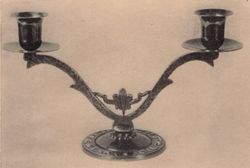
An example of a bronze Shabbat candlestick
holder made in Israel in the 1940s.

#10 a lotus vial in gold, #121 in silver, #140 in colored stone (malachite?); #35, 75, 175 rim of lilies; #195, 75 as buds. #35-38 are candle sticks. #30-34 are hooks, spoons, and other implements used in the Temple, 2.Chronicles 4:16; Exodus 35:15. The usage of these is as candlesticks with lotus flower holders. Buds among flowers and almonds are also mentioned as decorative items, Exodus 37:17ff, and can be seen on item#195 and 75. (Go to `Galleria' for more illustrations.) 1.Kings 7:49.The preferred floral ornament was the shoshana, translated as "lily" (lotus). 1.Ki. 7:26.


This concept is getting pretty heavy as it is totally disruptive to some religious conclusions about script"ures" so I will move on to the Greeks and song or hymn to Demeter, see my blog about Demeter and black women goddess figures in Africa for further background on Demeter and her relationship to Seshat.
Callimachus, Hymn 6 to Demeter (trans. Mair) (Greek poet C3rd B.C.) : "[Ostensibly a hymn for the Thesmophoria festival of Athens:] As the Basket comes, greet it, ye women, saying ‘Demeter, greatly hail! Lady of much bounty, of many measures of corn.’ As the Basket comes, from the ground shall ye behold it, ye uninitiated, and gaze not from the roof or from aloft--child nor wife nor maid hath shed her hair [i.e. the locks were dedicated at puberty]--neither then nor when we spit from parched mouths fasting [i.e. the Nesteia, the second day of the Thesmophoria, a day of fasting]. Hesperos [the star Venus] from the clouds marks the time of its coming: Hesperos (the Evening Star), who alone persuaded Demeter to drink, what time she pursued the unknown tracks of her stolen daughter [Persephone]. Lady, how were thy feet able to carry thee unto the West, unto the Melanoi (Black Men) and where the golden apples are? Thou didst not drink nor dist thou eat during that time nor didst thou wash. Thrice didst thou cross Akheloios with his silver eddies, and as often didst thou pass over each of the ever-flowing rivers, and thrice didst thou seat thee on the ground beside the fountain Kallikhoros (Callichorus) [i.e. the well at Eleusis], parched and without drinking, and didst not eat nor wash.