Sunday, February 12, 2012

Norse's Yggdrasil and the Tree of Life

Written 2/12/12
Yggdrasil is the tree of life of the Old Norse. sacred tree at Uppsala was a sacred tree located at the Temple at Uppsala, Sweden, an evergreen tree. The European Yew grows in Northwest Africa, Iran,Europe, and Southwest Asia. In the Canon of Medicine (1021) the drug from this tree was named Zarnab, and was used as a cardiac rememdy. It is used today in a synthetic form for chemotherapy and in the Central Himalayas, the plant is used as a treatment for breast and ovary cancer. Taxanes, which comes from the plant,  freezes mitosis and stops cell division. Coincidence that such a plant has been honored as the tree of life among some cultures who have kept Egyptian science embeded in their rituals.  Ancient KMT medical science restored. (from my notes dated 6/28/11).

Tomb of Pashedu, Valley of the Kings
Tree, Snake,
Yggdrasil is commonly held as the Ash Tree. I found this noteworthy because this week (2/10/12) I was searching for the etymology of Nashville as I was preparing an itenerary to create a "Discovering Egypt in Nashville" tour. Interestingly, Ash is in the olive and lilac family. What was interesting to note for me was that Ash exudes a sugary substance that was fermented to create the Norse "Mead of Inspiration". My quest for the meaning of Nashville brings me back to Seshat! Yet again connecting masonic thinking to ancient Egypt. I say masonic in reference to the architecture and name for Nashville. While Nashville has several noteworthy architectural references to Egypt finding a suitable name for the city was also of importance. The sound Nash is said to come from Atten Ash which means near an ash tree. We will see stories from Egypt of those near the tree. The term Nash was a shortened form of Aten ash in old English. The Ate was dropped phonetically. Other related terms include Ash/As, Ashemu, Ashtoreth, Ashorath, Ishtar, Isis, and Astarte.
Tomb of Thutmosis III, KV34,
1400s BC 18th Dynasty
Breast-like fruit growing from the trunk of the sacred yaxche tree

According to Norse mythology drinking the milk of the Ash tree makes one a skald or scholar. Is it no wonder that Nashville is home to so many colleges.

One website on the tree of life notes,
"In tomb depictions, the deceased, frequently accompanied by his wife, was shown sitting under or near the branches of a tree, with Hathor sprouting from the trunk, enjoying the fruit and drink offered by this goddess. An excellent example of such a representation is in the Theban tomb of Sennedjem.
Scenes and inscriptions clearly show a link between the tree-goddess, the symbol of renewal, and the dead in the form of the avian Ba, for as a bird, the soul of the dead was attracted to, and nourished by the tree."
As in its ancient Egypt and South America, the Norse retelling of the script also uses the representation of a bird.
Chased by Suttungr, Odin spits the mead of poetry into several vessels.
Jakob Sigurosson, 18th century Icelandic artist.
File:Odin wins for men the magic mead by Willy Pogany.png
Ogdin wins for men the magic mead
In this version of the story the "rhymester's share" (skaldfifla hlutr) could be drunk by anyone. However the mead of poetry was given by Odin to the Gods and to the men gifted in poetry. I think of rappers delight.... In the Norse story it references Aegin, a god coming from the sea (foreign). The Ae combo was a representation of the tree goddess in script.  this further connects the Norse's Yggdrasil with the Egyptian Tree of Life. Scholars/Skalds are shown to be connected to Ssh/she who scrivens/7/tree goddess in many cultures. Knowledge, script, and stories wrapped in parables exist cross culturally  that tie us to Lady Wisdom of the Pre-Dynastic times. Ancient Africa/KMT history told by authors across the world. The knowledge of self is transformative. 

I will leave you with some small tidbits on mead. I encourage you to search this subject and read my other blogs about mead, honey wine, and bees/honeycombs.  "Mead: In Scythia it was called medos; in Greece, methu; in India, madhu; in England, mead; in Old Irish, mid; in German, meth; in the Slavic countries, medu; in Lithuanian, medus; etc. The East-African nomadic races not only eat the wild honey but they dilute it with water and let it ferment into wine or beer called tetsch, which is their favorite drink. The African soothsayers and prophets intoxicate themselves with this honey-wine. During ceremonials and magical practices it is liberally used. They drink it from horns, like the Niebelungen used to do, and also distil it for brandy."

Friday, February 10, 2012

The Daughter of the Eye

Hide me in the shadow of Your wings Psalm 17:8
When I saw this picture I thought of scripture...as I sometimes gain clarity of script as I study KMT. This picture particularly brought to mind the single eye in the bible and the shadow of wings. For me it was a visual representation of the words I had read. So I just wanted to post this in this context for whats it worth. I will post more on the Egyptian origin of sayings compiled in the book of Psalms.
Matthew 6:22-23 (King James Version)
22 The light of the body is the eye: if therefore thine eye be single, thy whole body shall be full of light. 
Psalm 17:8
New American Standard Bible (NASB)
8 Keep me as [a]the apple of the eye; Hide me in the shadow of Your wings
Footnotes:
Psalm 17:8 Lit. the pupil, the daughter of the eye 
Footnotes: Psalm 17:8 Lit. the pupil, the daughter of the eye (seshat: she who scrivens, mistress of the house of books, lady wisdom...see my blog for more)

Saturday, January 21, 2012

Golden Apples and the Field of Holy Apples


There are two representations of tree, the tree of life and the tree of knowledge. Today science battles with the concept of divine creation. To study life and the spirit or to study nature and the mechanics of how things are made by ntr. There are teachers and writers about both schools of thought. Lets liken the learning obtained (degrees) to an apple on a tree, the fruit of the original author/designer/creator. The students are the common folks, like Adam and Eve. Today I am asking you what are the golden apples? Among the ancient text, what thought were they trying to convey by using metaphors such as bride, apples, and golden? And yet further, the names of these figures, what did they represent or personify? What "Lady" was stolen? And why did they travel to where the black men were, where the golden apples are found? I think that as we discover more about the history of the women scribes of Africa we will uncover much about human history that has been hidden in analogies. 

It is important that as we begin to unravel the history of ancient African in our modern 20th century context that we look to prehistory first and see what later scribes interpreted from their "old school". The connection to this concept and Africa is clear among the Greeks. We will talk more about theater, music, and festivals as it relates to Seshat and the Greeks in another blog. But for now I leave you this hymn and poem to ponder. I encourage those with an astronomy background to help decipher Hymn 6 to Demeter.


The Shekhinah as the Sabbath Bride
Legendary mystic of the 16th century, Rabbi Isaac Luria. Here is a quotation from the beginning of his famous shabbat hymn:

"I sing in hymns
to enter the gates
of the Field
of holy apples.

"A new table
we prepare for Her,
a lovely candelabrum
7 branched Candelabra
sheds its light upon us.
"Between right and left
the Bride approaches,
in holy jewels
and festive garments..."

A passage in the Zohar states, "one must receive the Lady with many lighted candles, many enjoyments, beautiful clothes, and a house embellished with many fine appointments".

It is from this culture that the term Shekinah, Shechinah, Shekina, Shechina arises after the consecration of the temple of Solomon. Perhaps a language expert could shed some light on how the etymology of שכן relates to S'sh3t. I would think that with the reference to Solomon, the temple, and building (divine architecture), the candelabra (light), Her, and apples mentioned, the passage is referring to Seshat, which is a title and not a name so it is well substituted among different cultures. Remember Seshat held the title also "Lady of the House of Books", and was commonly known as layer of the foundation of the temples, pyramids, and buildings. The Shabbat carries with it the symbolism and science of Seshat "symbolizing the Seventh Day in the Book of Genesis, after six days of creation. It is observed from sundown on Friday until the appearance of three stars in the sky on Saturday night. Shabbat is ushered in by lighting candles." according to one website.


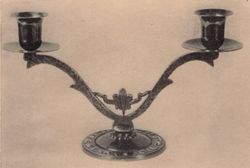
An example of a bronze Shabbat candlestick
holder made in Israel in the 1940s.

#10 a lotus vial in gold, #121 in silver, #140 in colored stone (malachite?); #35, 75, 175 rim of lilies; #195, 75 as buds. #35-38 are candle sticks. #30-34 are hooks, spoons, and other implements used in the Temple, 2.Chronicles 4:16; Exodus 35:15. The usage of these is as candlesticks with lotus flower holders. Buds among flowers and almonds are also mentioned as decorative items, Exodus 37:17ff, and can be seen on item#195 and 75. (Go to `Galleria' for more illustrations.) 1.Kings 7:49.The preferred floral ornament was the shoshana, translated as "lily" (lotus). 1.Ki. 7:26.


This concept is getting pretty heavy as it is totally disruptive to some religious conclusions about script"ures" so I will move on to the Greeks and song or hymn to Demeter, see my blog about Demeter and black women goddess figures in Africa for further background on Demeter and her relationship to Seshat.
Callimachus, Hymn 6 to Demeter (trans. Mair) (Greek poet C3rd B.C.) : "[Ostensibly a hymn for the Thesmophoria festival of Athens:] As the Basket comes, greet it, ye women, saying ‘Demeter, greatly hail! Lady of much bounty, of many measures of corn.’ As the Basket comes, from the ground shall ye behold it, ye uninitiated, and gaze not from the roof or from aloft--child nor wife nor maid hath shed her hair [i.e. the locks were dedicated at puberty]--neither then nor when we spit from parched mouths fasting [i.e. the Nesteia, the second day of the Thesmophoria, a day of fasting]. Hesperos [the star Venus] from the clouds marks the time of its coming: Hesperos (the Evening Star), who alone persuaded Demeter to drink, what time she pursued the unknown tracks of her stolen daughter [Persephone]. Lady, how were thy feet able to carry thee unto the West, unto the Melanoi (Black Men) and where the golden apples are? Thou didst not drink nor dist thou eat during that time nor didst thou wash. Thrice didst thou cross Akheloios with his silver eddies, and as often didst thou pass over each of the ever-flowing rivers, and thrice didst thou seat thee on the ground beside the fountain Kallikhoros (Callichorus) [i.e. the well at Eleusis], parched and without drinking, and didst not eat nor wash.

Thursday, December 22, 2011

The African Origin of Christmas & Seshat

7 Days Before The New Year (Christmas Eve) in Africa & Seshat and the Origin of Christmas Celebrations
Every year 7 days before the New Year the Ancient Egyptians would pay homage to the goddess of the tree of life (paut neteru­ ­), Seshat. These 7 days would culminate with a great festival on the New Year.

There would be theatrical reenactments such as the script written in what was published as The Book of Thoth, The Opening of the Mouth Ceremony, and the Stretching of the Cord Ceremony. Theatrical reenactments were accompanied by music, food, and just a general festive atmosphere. The celebratory day was preceded by gift giving. It is the origin of these rituals that interest me in their connection with Seshat.
There are two themes I will explore in this blog that I found striking connecting Seshat to the rituals still practiced today:
  1. Ancient rituals (Old Kingdom) associated with current holidays (holy days): There are obvious connections with the Bible and Jesus published thousands of years after the origin of these ceremonies, festivals, and books. The Book of Thoth has script that is also found in the Holy Bible. The integration of these concepts in theater through plays were central both in ancient Egypt and in Germany, where the Christmas tree tradition was first recognized by Europeans. 
  2. Linguistic, architectural, and artistic similarities: The symbol for Seshat has been correlated in ancient times among the Hebrew as parallel with the symbol used for Jesus as evidenced in this Urn.
The goddess of the New Year was Seshat, the goddess and the symbolism in which her figure embodied is so old she was nameless for millenniums that followed. The priest were not to utter her name. To know her name and to be able to call her name was of great significance. To call her name at the hour of the New Year, which was tied to astronomy, was said to be the most powerful time to do so, because a portal was to be open at that moment where the voice could be "heard" so to speak. This Hr of the start of the NY was marked by great celebration among the Egyptians, as we do today with the drop of the apple in NY, another symbol of education and wisdom. The first of Thouth/Thuthi/Thoth, 9/11, was a name attributed to this day in later Dynasties. However the New Years Festival predates Djehudi, it predates the 4th Dynasty of Ra, and is mentioned in text prior to the 1st Dynasty. It is associated with the heliacal rising of Sirius (Sopdet/Sothis) and Pleiades prominence in the sky. This season was also dedicated to Hapi/Hapy/Happy

Seshat means "she who scrivens", meaning the women who writes, the author. Among the early literate she was identified as the original author. What her symbol embodied was the beginning of hieroglyphic writing, the knowledge contained in those books and taught in the schools of ancient Egypt to scholars. With subjects ranging, but intricately connected, to Astronomy, Alchemy, Chemistry, Architecture, Herbology, Medicine (Farmacopia), and Anatomy. 
  1. The architecture included site selection and orientation, which later became ritualized into the Stretching of the Cord Ceremony and reenacted at the New Years festival. This is the same ceremony found in the Book of Solomon. Solomon (reigned c.970-c.930 BCE) was very learned from the books of Seshat. In the Testament of Solomon (700-300 AD) he was called upon by the Hebrew to help construct the First Temple of Jerusalem. The science of Seshat embued in architecture legitimized the churches because its orientations were directed by her knowledge and tools for its astrological proper alignment. Seshat was the great architect among the ancient Egyptians. The "sanctuary contained the seven branched candlestick, the table of showbread and the Incense Altar." and "an Ezrat Nashim (Women's Court) to the east and main area to the west". The table of shewbread or table of Presence was made of acacia wood overlaid in pure gold. I may try this for my holiday party for the 12 days of Christmas as we come into the New Year of 2012. Maybe with a pyramid shaped meat filled sambusas.
Symbols of the Christmas Tree

Nhaha (flail) & Heka (Crook)
Candy Cane from my tree 2011
This month at a Christmas party I talked about my coming book on Seshat and showed the picture at the top of this blog to my friends and family. I had already noticed similarities between the dates of Christmas, the Christmas Tree, and Seshat, who was also correlated with Christ in early Hebrew artifacts that have been found. But when I walked by my Christmas tree it all began to come together clearer. The first thing I noticed was the candy cane hanging on the tree. The Crook, Crozier or Heka, is symbolic of the shepherd among the Egyptians and others of African culture as is the candy cane among early Americans. The Crooks in the above photos are striped. The popular colors of Christmas are also represented in the red, white, green, and gold of the ancient Egyptian art.


Angel Tree Topper holding Stars


I will write more in another blog about the Tree of Knowledge and the apple of the Bible and how it relates to Seshat. However, the topper of the evergreen tree of life is undeniably related not just to Egypt but to Seshat herself. At the top of most Christmas trees you will find an Angel, not a Shepherd or anything else, but a Women or a Star as shown atop Seshat's head as her tool and symbol which was said to connect constellations, such as Orion and Sirius, to determine the proper alignment for the foundation of the temples. The heliacal rising of Sirius marked the New Year. Recordings were to be done on the everlasting papyrus/paper which transcended time and imparted the knowledge and science of early writers for us to view today, 7,000 years later. The people of ancient KMT gave gifts each year beginning 7 days before the New Year.


Portal of the House of the Blackheads
One link to all this is the Brotherhood of the Blackhead, founded as a military organization. Members included foreign (to Estonia & Latvia) ship owners, merchants, goldsmiths, chemist, scholars, and school teachers...(sound familiar?). According to Wiki:
 Patron saint of the 

Brotherhood of Blackheads,

 Moorish Saint Mauritius.

(indigenous African in full armour, 
bearing a standard and a palm; 
knight in armour with a 
red cross on his breast, 
which is the badge of the
 Sardinian Order of Saint Maurice) 
born 3rd century. Thebes, Egypt.
in the Cathedral of Madgeburn, 
1250 A.D. Germany
(oldest Gothic cathedral
 in Germany (9/21/937)
"Blackheads commit themselves to decorating and lighting the altar of St. Mary"....Twice a year the Brotherhood celebrated major holidays: at the end of the navigation season during between December 24 and January 10 Christmas and New Year, and from Easter to the beginning of the navigation season. Both celebrations commenced with an official session where organizational matters were settled, and continued with feasts, dancing, and festivities that sometimes included the whole town. The custom of erecting a Christmas Tree can be historically traced to such activities in the 15th and 16th centuries. According to the first documented uses of a Christmas tree in Estonia, in 1441, 1442, and 1514 the Brotherhood erected a tree for the holidays in their brotherhood house in Tallinn. At the last night of the celebrations leading up to the holidays, the tree was taken to the Town Hall Square where the members of the brotherhood danced around it.[4] In 1584, the pastor and chronicler Balthasar Russow wrote of an established tradition of setting up a decorated spruce at the market square in Tallinn where the young men “went with a flock of maidens and women, first sang and danced there and then set the tree aflame”.[5] The first description of a Christmas tree used the Brotherhood in Riga in 1510 resembles the descriptions from Tallinn. Also as this church is held a baptismal font dated several thousand years old brought from Gebel Abu Dokhan near Hurghada, Egypt. It is made of red porphyry from a single quarry in the Eastern Desert of Egypt, from 600 million year old andesite of the Arabian-Nubian Shield, an area known for its watering wells and marked by hydreumata. Porphyry was extensively used in Byzantine monuments such as in the Hagia Sophia or Holy Wisdom. Sophia comes from "Wisdom" in Latin. The Church of the Holy Wisdom, 360AD, was said to have "changed the history of architecture". It was designed by scientist and a mathematician. Justinian proclaimed at its completion, "Solomon, I have outdone thee!". Its dedication feast takes place on 25 December, when the church was dedicated to the Logos, the second person of the Holy Trinity. Logos, originally meaning "word" it became a technical term (ca 535BC-475BS) in philosophy for a principle of order and knowledge. Wisdom is a central topic in the "sapiential" books, i.e. Proverbs, Psalms, Song of Songs, Ecclesiastes, Book of Wisdom, and Wisdom of Sirach. See also 1 Corinthians 1:20 "Where is the wise? Where is the scribe?". "n the liturgy of the Orthodox Church, the exclamation Sophia! or in English Wisdom! will be proclaimed by the deacon or priest at certain moments, especially before the reading of scripture, to draw the congregation's attention to sacred teaching."
The church also houses a statue of Jesus nailed to a tree, Lebensbaumkruzifix (literally: Tree of life cross) 1986. In 1510, according to the National Christmas Tree Association, the merchants decorated the tree with artificial roses, danced around it in the marketplace and then set fire to it. This practice reminds me of the burning bush mentioned in the bible and references to the tree of life. The rose was considered a symbol for the Virgin Mary. By the 17th century it became common in Germany to decorate the tree with apples. An object noted in the bible to represent knowledge and wisdom.
One educational site says this about the origin of the first Christmas tree,

"The origin of the first Christmas tree dates back to the Middle Ages in Western Germany. The people during this time period participated in and watched dramatic plays called miracle and mystery plays. These plays were performed to teach the common people about religious truths that were contained in the bible. There were no printed books available, and pictures were scarce during this period of time. "As laymen joined with the clergy, the individual plays were arranged in a lengthy series or cycle throughout the church year" (Foley, pg. 39). In this way, peasants were taught about the Old and New Testaments of the bible.During the Christmas season, the Paradise play was presented. This play depicted Adam and Eve in the garden of Eden. On stage was an evergreen tree, covered in apples, which showed Adam and Eve's sin and later banishment from the garden. The tree received particular attention because it was the only prop on the stage. This symbol remained firmly planted in the minds of spectators and actors. Later, after the plays "ceased to be performed in Germany" ( Foley, pg. 41), people began putting their own trees in their homes."....."Candles were also important symbols to the Germans. The candle was their main source of light, and it represented Christ being the Light of the World. The candles were placed on a wooden pyramid structure with shelves called the lightstock or Christmas pyramid. This pyramid stood next to the Paradise tree. This candle holder was also decorated with tinsel, paper or cloth roses, and a star was usually placed on top."

"The Moravians made more of Christmas than any other religious denomination in this country from Colonial times. On Moravian.org, "Moravian stars are connected to math lessons in school where students learned to draw and make geometrical shapes. One of the shapes was a pyramid. At the Moravian boarding school in Niesky, Germany, pupils practiced by making shapes from paper.....The first account of a star made specifically for Christmas dates from 1867 when Hermann Bourquin, a former pupil at Niesky, made a paper star for his parents in Herrnhut.....The Moravian star is distinguished by its well-proportioned shape. The length of the points corresponds proportionally to the diameter of the body."Such a rich consistent history...

During the 1800s, according to Christmas in Pennsylvania, Philadelphia was known for its Carnival of Horns, the marching bands, young men costumed in mock military equipment, with fireworks and parading in the streets. This book makes notes of the Bishop of Worms, who in the 11th century cautioned his priests against the people's custom of wearing animal skins and masks on the calends of January (i.e. January 1). Shoemaker notes this is the earliest reference to a practice that found expression in the Belsnickel custom of the Pennsylvania Dutch culture. This is also linked to the medieval Shrove Tuesday Fastnacht. Looking back at the Brotherhood of the Blackheads, the military tones of Christmas parades now make sense to me. The New Years Eve type festival/parade connection is brought together. Considering the early starters of this tradition were largely merchants and teachers I know hold a deeper understanding of store and school closings during this time period across the nation in preparation for and to celebrate these two holidays.

For more on my finding of the connections between America, Europe, and Africa around the winter solstice see my Happy New Year blog I published 1/1/11.

Foley, Daniel J. (1960). The Christmas Tree. Philadelphia: Chilton Company.
Bodum, Herman (1836). The Stranger's Gift. Boston.

Wednesday, December 21, 2011

Saving African Libraries: Egyptian Library Burned December 19, 2011

Today I saw a post on Facebook about The Scientific Institute's Library in Egypt that had been burned. I immediately cringed as I have been yearning to increase my knowledge base on early books in Egypt and have even contemplated returning to graduate school to learn more for my studies on the vast body of knowledge and books that have gone untapped and analyzed from my perspective. The Scientific Institute was built in 1798 on the order of Napoleon Bonaparte. I have been writing about Napoleon yesterday in my journal which at the top reads Napoleon-Africa-St Maurice-New Orleans.

You can read details about the this incident here: The Egyptian Scientific Institute in Cairo, and watch the video below.


Here is a YouTube video of the fire. I am no museum curator but I hardly think that the proper way to care for the books after a burning is the step on them in a large truck and allow so many to handle then in this way. Caring for our national treasures takes a community. We have to share our knowledge and resources with countries that are not equip with the proper tools to ensure that these treasures are around for future generations. This incident is testimony to the fact that we most make a concerted effort to properly preserve our ancient libraries. What is a city without its libraries? What are a people without knowledge of where they come come? It is imperative that we maintain all books for we never know what new insights future generations may gain from them that we do not see.

Saturday, December 17, 2011

The Ancient Egyptian Theater -- Early History Plays?

The papyri which are described as the Book of Thoth are written in a manner that looks like the pages of a script book. Stage directions and who says what are clear. Having been involved in theater myself, when I read the papyri I see a script. A script for a play to be performed.

Who were they performing for? The temples in Egypt are grand indeed. The festivals were grand, or can I say celebrations? Seshat was honored in the New Years celebrations. Were these "scripts" recorded and protected for thousands of years the best plays to be performed at these highly attended and much anticipated events?

While reading the Book of the Dead, or shall I say Living, I noticed that the term "spells" were used. When I looked up the meaning of spells in the hieroglyphic term it connotates "words to be spoken". To me this means the words that follow are to be said out loud, not read. That the "spells" were "lines".

Why have scholars not studied in depth the possibilities of theater in ancient Egypt, before Greece existed. Why is there no serious discussion of the ancient scripts as plays to be performed, whether in the temples, festivals, or shows of other forms.

Animals and their representations in these scripts that were meant to be spoken are prominent. Children today love to be entertained by animals. Schools today teach the alphabet, learning concepts, and reading through the usage of animals. Is it fair to say that the Africans in Egypt did the same thing thousands of years ago?

Sunday, August 28, 2011

Izapa Stela 5 Seshat and Early Egyptian Writing

There are several studies that address the early writings of Africa and how they have shown up in the Americas. I will begin to touch on them here. There are also more concrete correlations between Thoth/Seshat and these gods/goddesses represented in the language and script of the early writers in South America. I will go into detail about this aspect in another post.
Izapa Stela 5
"Some researchers claim that the Mesoamerican writing systems are related to African scripts. In the early 19th century, Constantine Samuel Rafinesque proposed that the Mayan inscriptions were probably related to the Libyco-Berber writing of Africa.[7] Leo Wiener[8] and others claim that various Olmec and Epi-Olmec symbols are similar to those found in the Vai script, in particular, the symbols on the Tuxtla Statuette, Tao Mask, Cascajal Block, and the celts in Offering 4 at La Venta. These assertions have found no support among Mesoamerican researchers. While mainstream scholars have made significant progress translating the Maya script, researchers have yet to translate Olmec glyphs."

Also, there is an online document called Ancient Mariners in America that is noteworthy that has also addressed the writing that the Libyan women practiced, Tifnag, and its occurrence in the United States.

"Tifinag lettering originated in Mauretania, where it is still in use among the Berbers in the Atlas Mountains. Examples of these lettering forms are scratched on cave shelters and rock outcrops throughout the United States and Canada, and in North Africa. Universities in present- day Algeria, Morocco and Libya, having worked with Dr. Fell, can verify and translate the ancestral scripts housed in the archives and libraries."